Article

Celebrate Fall Foliage with Autumn Art at the National Gallery

3 min read
We look out onto a sweeping, panoramic view with trees, their leaves fiery orange and red, framing a view of a distant body of water under a sun-streaked sky in this long, horizontal landscape painting. The horizon comes about halfway up the composition, and is lined with hazy mountains and clouds in the deep distance. Close examination slowly reveals minuscule birds tucked into the crimson-red, golden yellow, and deep, sage-green leaves of the trees to either side of the painting. Closest to us, vine-covered, fallen tree trunks and mossy gray boulders line the bottom edge of the canvas. Beyond a trickling waterfall and small pool near the lower left corner, and tiny within the scale of the landscape, a group of three men and their dogs sit and recline around a blanket and a picnic basket, their rifles leaning against a tree nearby. The land sweeps down to a grassy meadow crossed by a meandering stream that winds into the distance, at the center of the painting. Touches of white and gray represent a flock of grazing sheep in the meadow. A low wooden bridge spans the stream to our right, and a few cows drink from the riverbank. Smoke rises from chimneys in a town lining the riverbank and shoreline beyond, and tiny white sails and steamboats dot the waterway. Light pours onto the scene with rays like a starburst from behind a lavender-gray cloud covering the sun, low in the sky. The artist signed the painting as if he had inscribed the flat top of a rock at the lower center of the landscape with his name, the title of the painting, and date: “Autumn – on the Hudson River, J.F Cropsey, London 1860.”
Jasper Francis Cropsey, Autumn - On the Hudson River, 1860, oil on canvas, Gift of the Avalon Foundation, 1963.9.1

Bask in the glow of the afternoon sun radiating from the center of this painting. Let your eyes travel to its colors: green, gold, and the fiery blaze of leaves turning red.

In Autumn – On the Hudson River, Jasper Francis Cropsey captures the splendor of North American fall. This monumental work stands 5 feet tall and stretches 9 feet across. To make it, Cropsey carefully observed the trees on the banks of the Hudson River. He painted them so faithfully that individual species can be identified: elm, birch, red oak, maple, American chestnut, and the evergreen hemlock and pine trees.

But when he first exhibited this work across the Atlantic in London in 1860, British audiences were skeptical that such brilliant foliage could be real. Leaves in the UK and Europe turn mostly yellow in fall, while those in North America favor towards red and orange. In response, Cropsey mounted American autumn leaves next to the painting as proof.
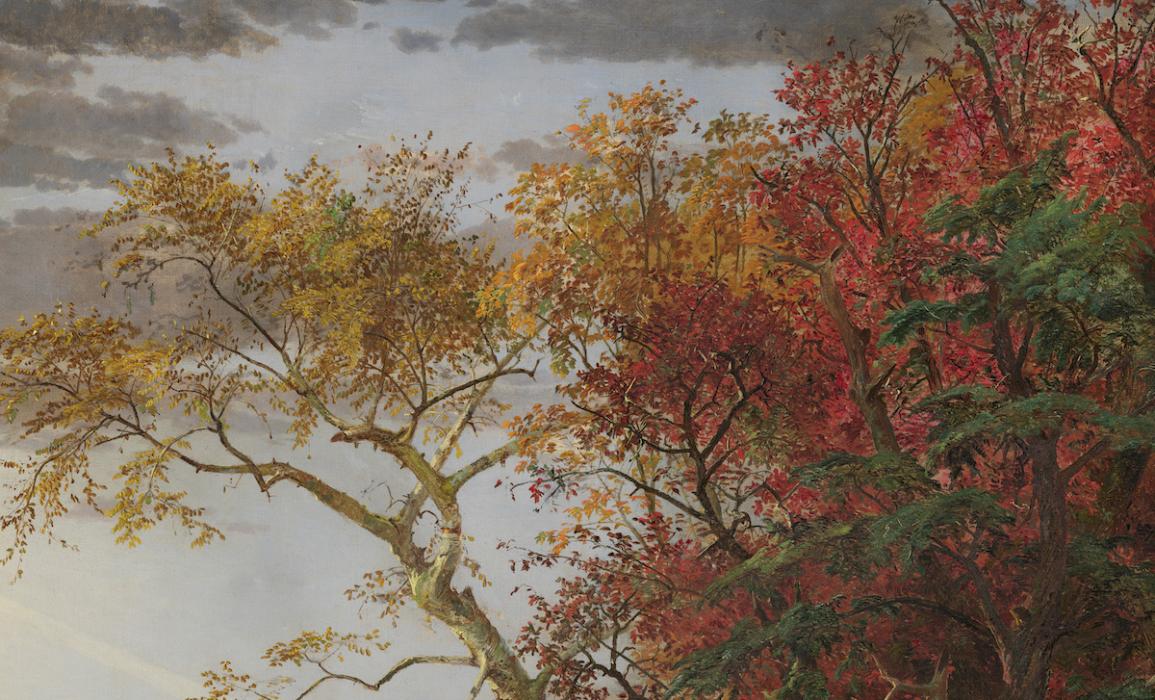
Detailed closeup of leaves on the right side of Cropsey's Autumn – On the Hudson

Jasper Francis Cropsey, detail of Autumn - On the Hudson River, 1860, oil on canvas, Gift of the Avalon Foundation, 1963.9.1.

No matter where you are in the world or what seasons you’re passing through, take this scene as an invitation to pause and notice changes in the natural world around you. And if there isn't currently a riot of color or brisk fall breeze where you live, spend some time with our autumnal images.
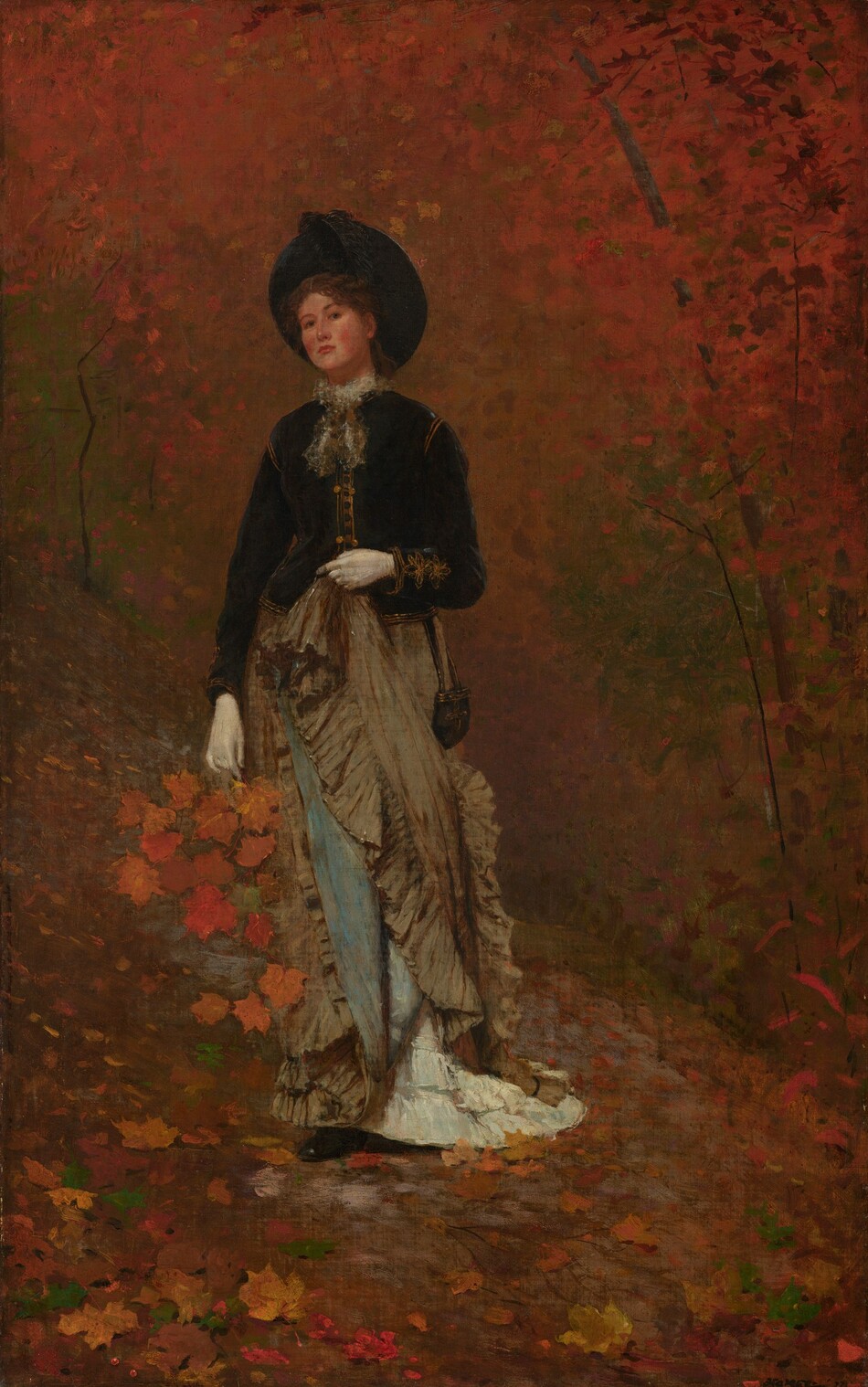
 

  • A woman with smooth, pale skin and wearing a hat, long dress, and gloves, stands holding a bunch of pumpkin-orange leaves against a background of trees painted with touches of rust orange and pine green in this vertical painting. The woman tips her head back slightly to look at us with dark eyes under arched eyebrows. Her cheeks are flushed and her coral-pink lips closed. Her round black hat perches on the back of her head and she has an inky black, long-sleeved, hip-length jacket with bronze trim at the shoulders, cuffs, and down the front. A gauzy bow is tied at her neck. Her left elbow, on our right, is bent and she holds up her tan-colored, ruffled skirt with a white-gloved hand. The raised skirt exposes sky-blue lining and white, ruffled flounces at her feet. Her right arm, on our left, hangs at her side and holds the handle of a basket. Deep marigold-orange leaves cascade out of the basket. One black shoe peeks out from under her long skirt. She stands on a hill carpeted with crimson-red, tawny-brown, golden yellow, and forest-green leaves. The space behind her is filled with touches and dabs of red, orange, brown, black, and tan.
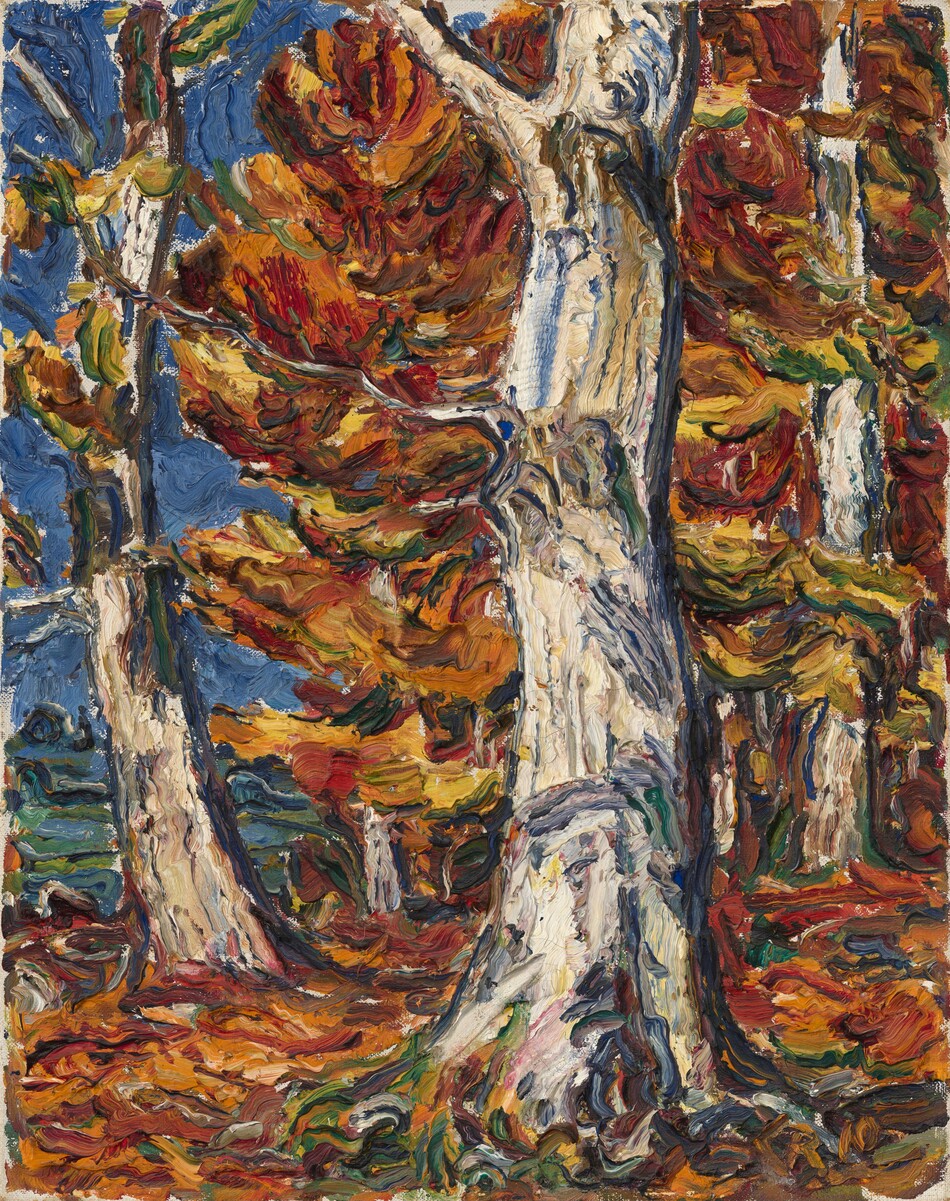
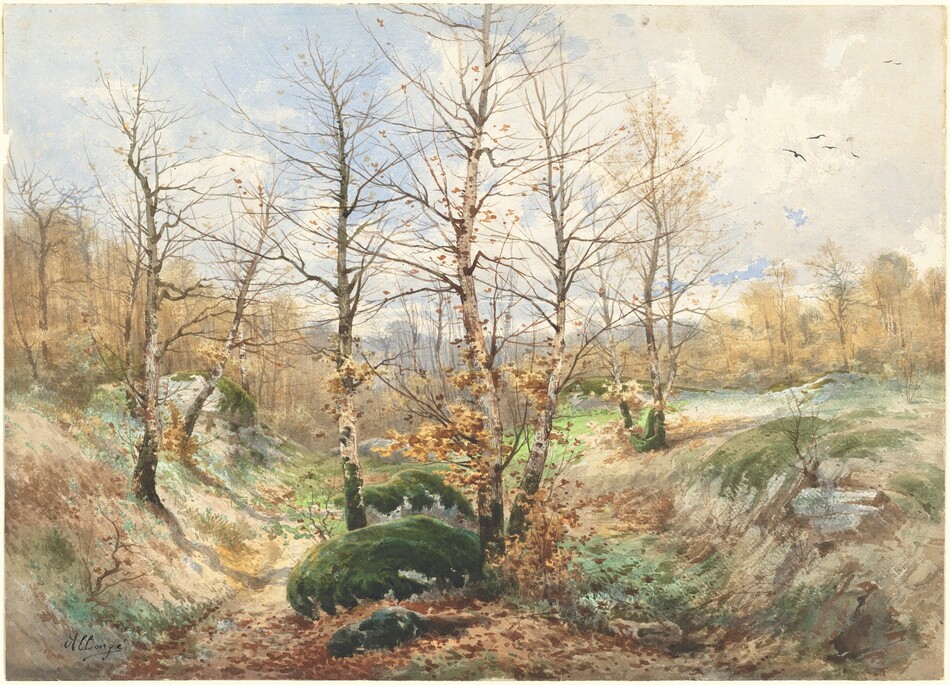
  • The painting depicts birch trees and autumn foliage. The composition is filled with white-gray tree trunks and colorful leaves. The largest tree is to the right of center, beginning at the bottom of the painting and appearing to continue beyond the upper edge. The color palette includes deep oranges, reds, and yellows for the leaves, with some dark blues and greens suggesting shadows. The dark-blue sky is partially visible behind a tree on the left. The paint has been applied in thick, swirling strokes.
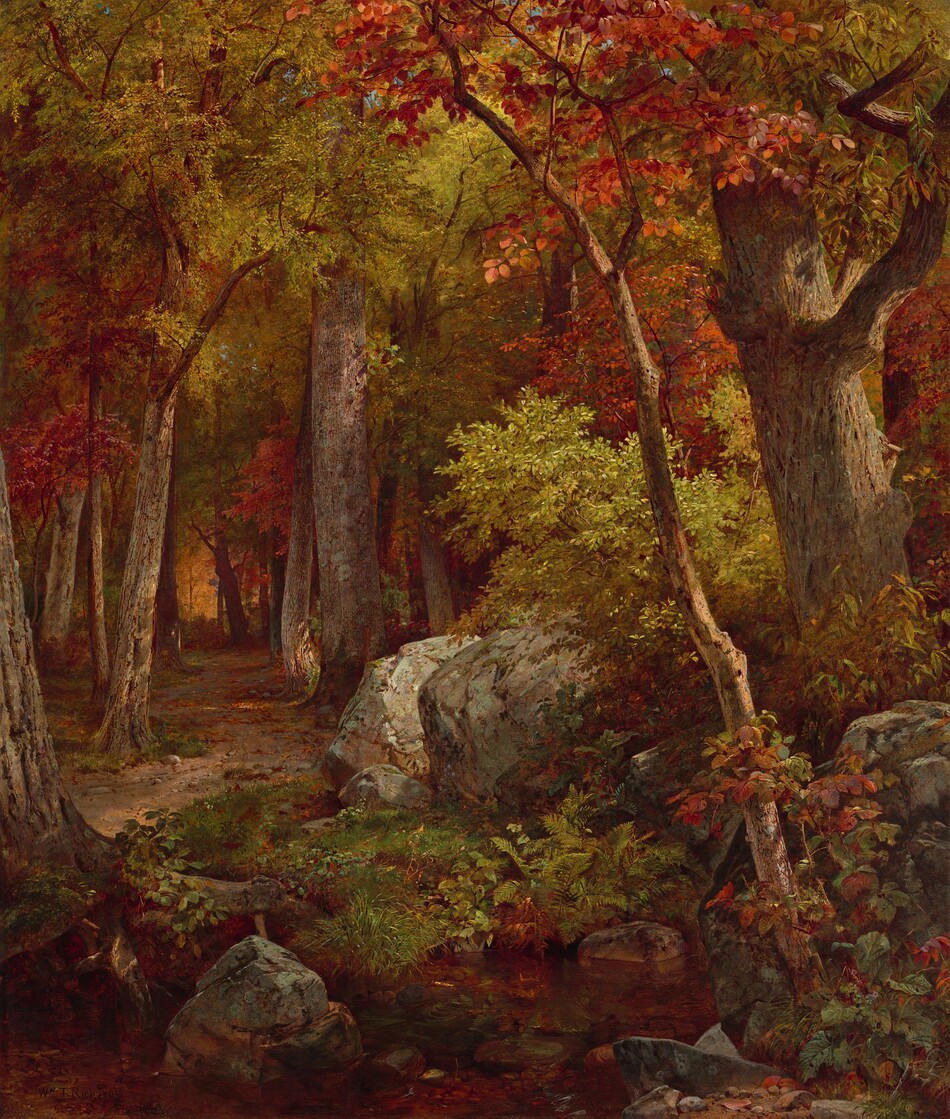
  • A dirt path winds through a dense forest with leaves that glow gold around silvery-gray boulders in this vertical landscape painting. Close to us, the boulders are partially covered with moss and growth in shades of green and russet red. Sunlight from the upper right catches a sapling crowned with flame-red leaves that angles in from the lower right corner of the painting. Beyond it leafy yellow-green shrubs crowd beside two more putty-gray boulders. The path recedes just left of center and is lined by trees covered with rough bark. The path ends at a fiery copper glow in the distance. The artist signed and dated the painting in the lower right corner: “WM. T. Richards Phil. 1863.”
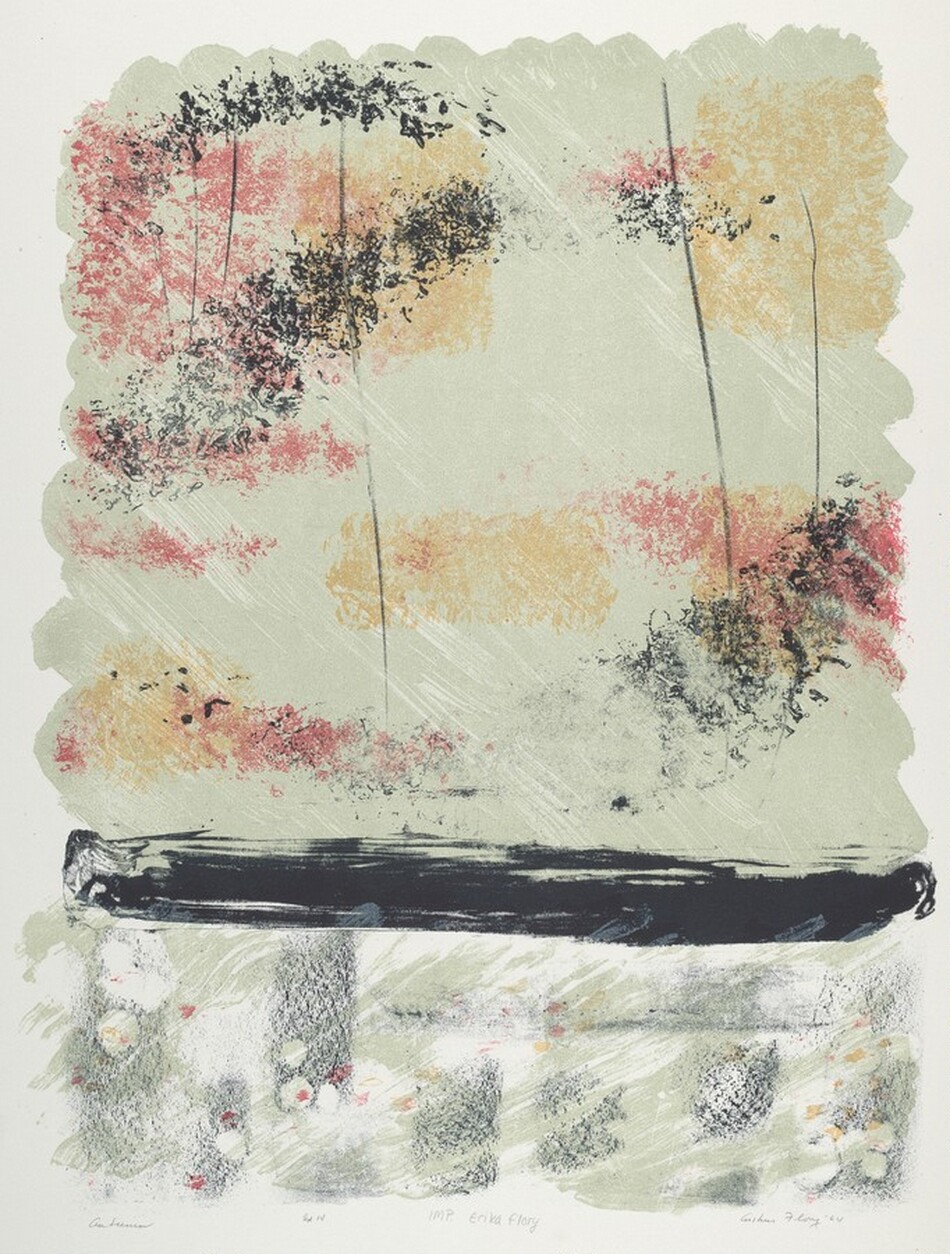
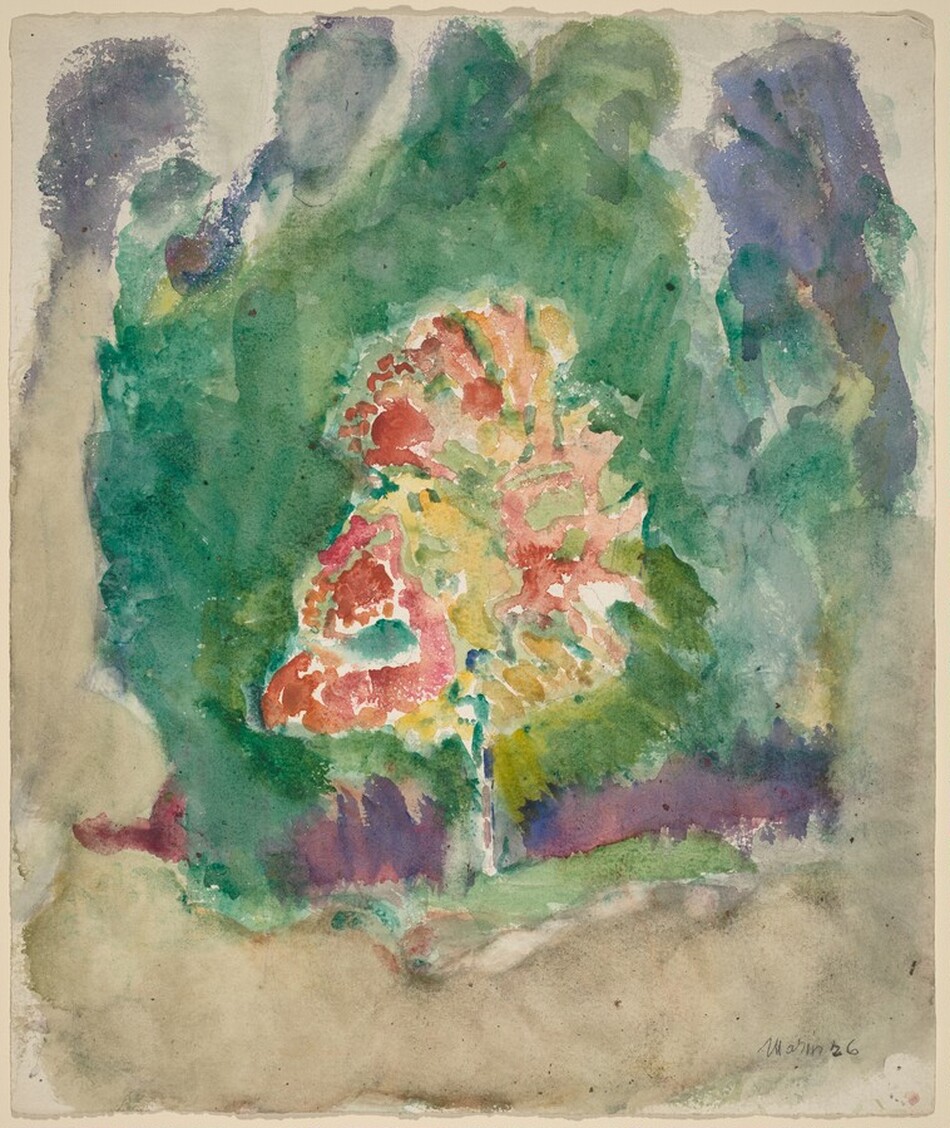
  • The image displays an abstract composition of textured lines and blotchy shapes in various shades including black, red, and mustard. The shapes resemble clusters of foliage on tall tree trunks. A thick horizontal black line runs across the width. Circular shapes with blurred edges are scattered in the lower section. The composition is enclosed in an uneven, wavy outline.
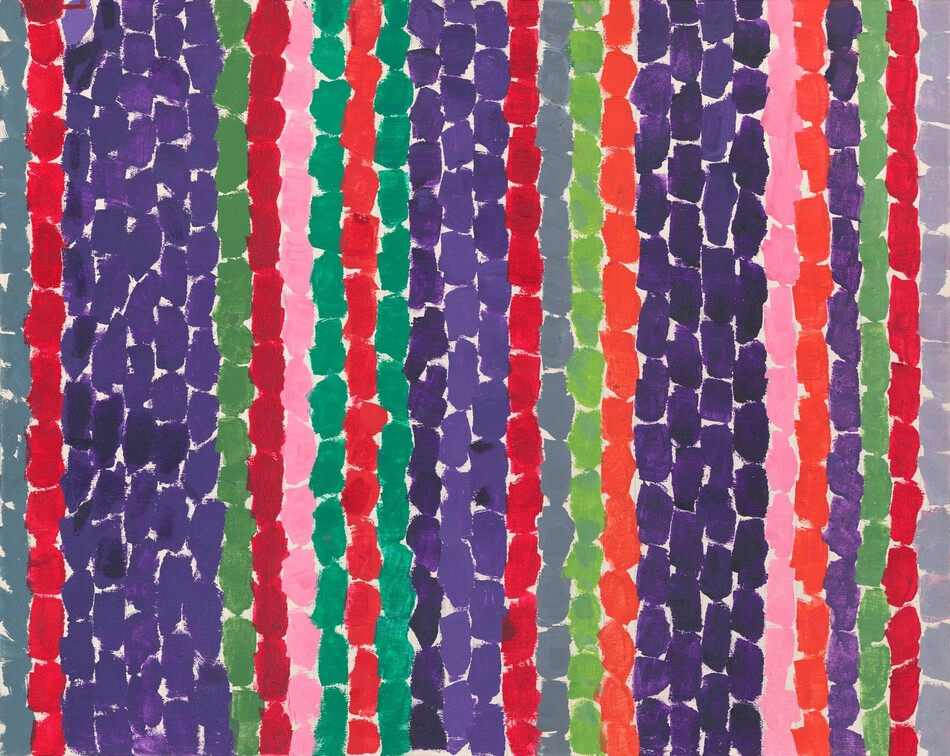
  • This painting is a composition of vertical lines made up of irregular segments. These lines are in various colors, and have been made with short, distinct brushstrokes. The lines are in purple, green, pink, red, and gray hues. Some of the white of the canvas is visible between the brushstrokes.
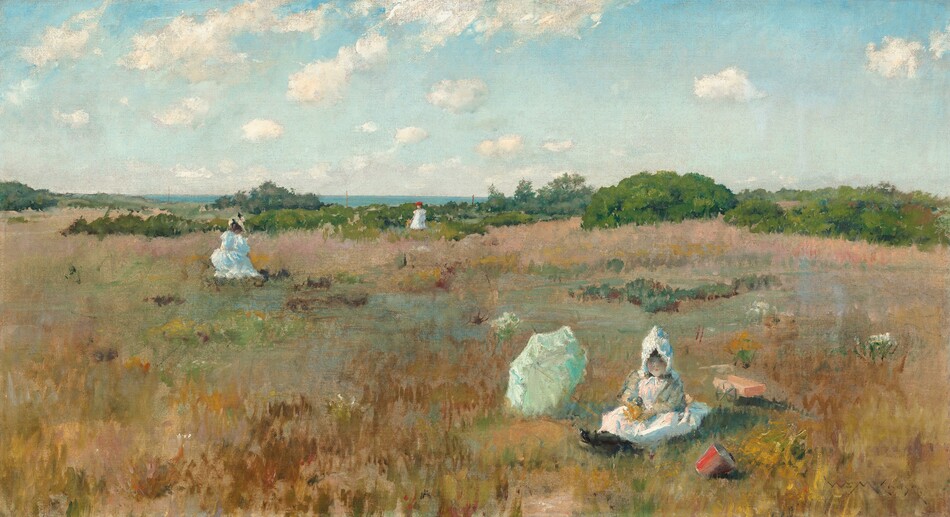
  • The painting depicts a golden, grassy landscape with low green trees in the distance, leading towards vibrant blue water on the horizon. The field is streaked with patches of brown, light pink, light blue, rusty red, dark green, and dark red. People dressed in white are scattered throughout the field; closest to us, on the right, a child sits in the grass next to a pale green parasol. The child has pale skin, rosy cheeks, and dark hair visible under a white bonnet. They wear a white gown and black shoes, and they hold something yellow on their lap. In front of them is a red bucket, and behind them is a small orange cart. Farther away from us, on the left, a woman in a long white dress and a tan hat kneels or sits in the grass, and to the right another person stands even farther away near the low green trees, wearing a white dress and a red hat. The sky above is light blue, with soft, fluffy white clouds drifting across it. The painting employs soft, loose brushstrokes.
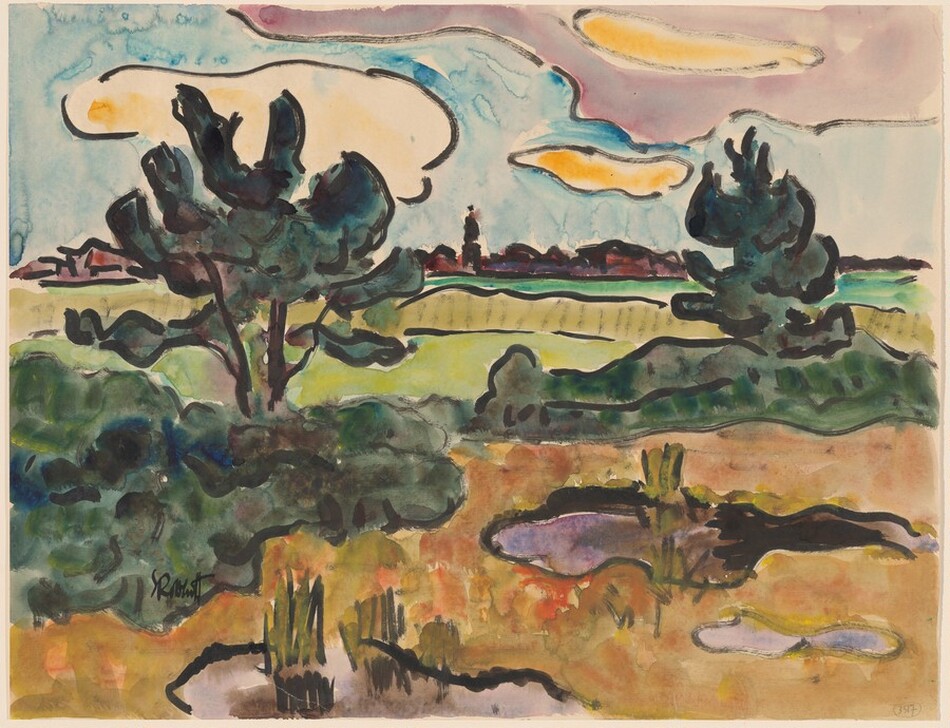
  • The image depicts a landscape with trees and a small structure on the horizon. The brushstrokes are expressive and loose, with bold outlines defining the trees and sky. The color palette includes greens, browns, yellows, blues, oranges, and purples. The sky shows a mix of pale blue and purple tones.
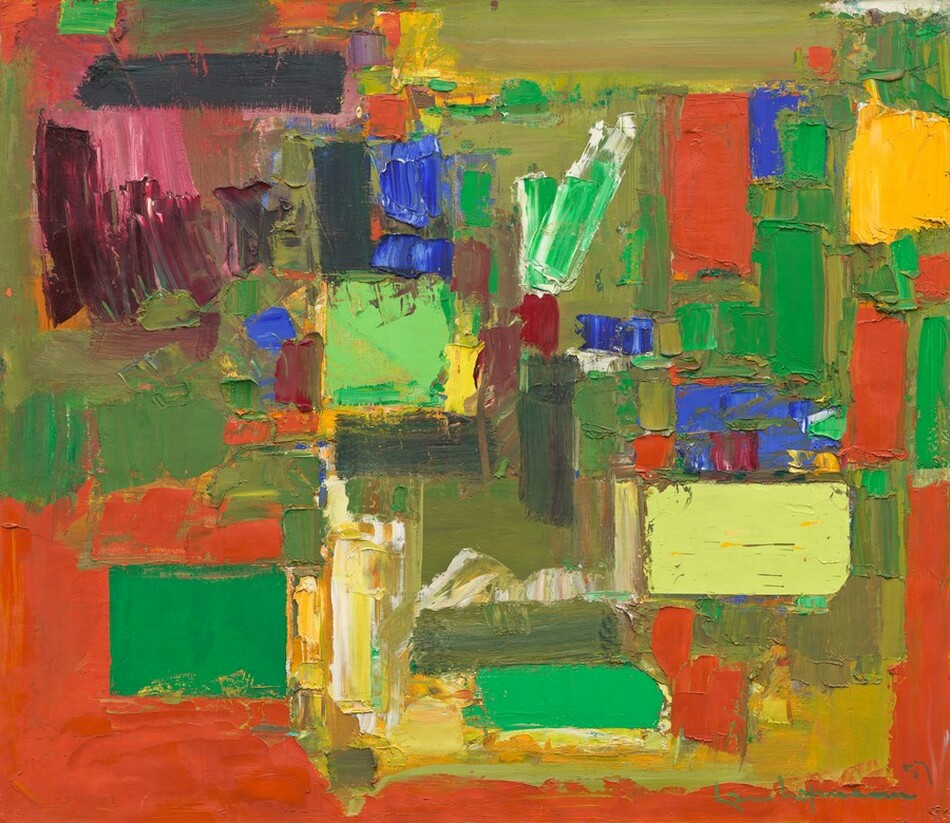
  • Thickly painted, rectangular vertical and horizontal slabs in intense buttercup and mango yellow, shamrock and lime green, burnt orange, raspberry pink, and charcoal gray are layered in this nearly square, abstract composition. In the top half, shapes are smaller, closer together, and separated by strokes of moss green. In the bottom half, the shapes are larger and seem to float against a vivid orange background. Smaller swipes and dabs of cotton candy pink, plum purple, indigo blue, sea glass green, scarlet red, rust brown, and bright white are interspersed around the slabs. The artist signed and dated the painting in green paint in the lower right corner, “hans hofmann 57.”
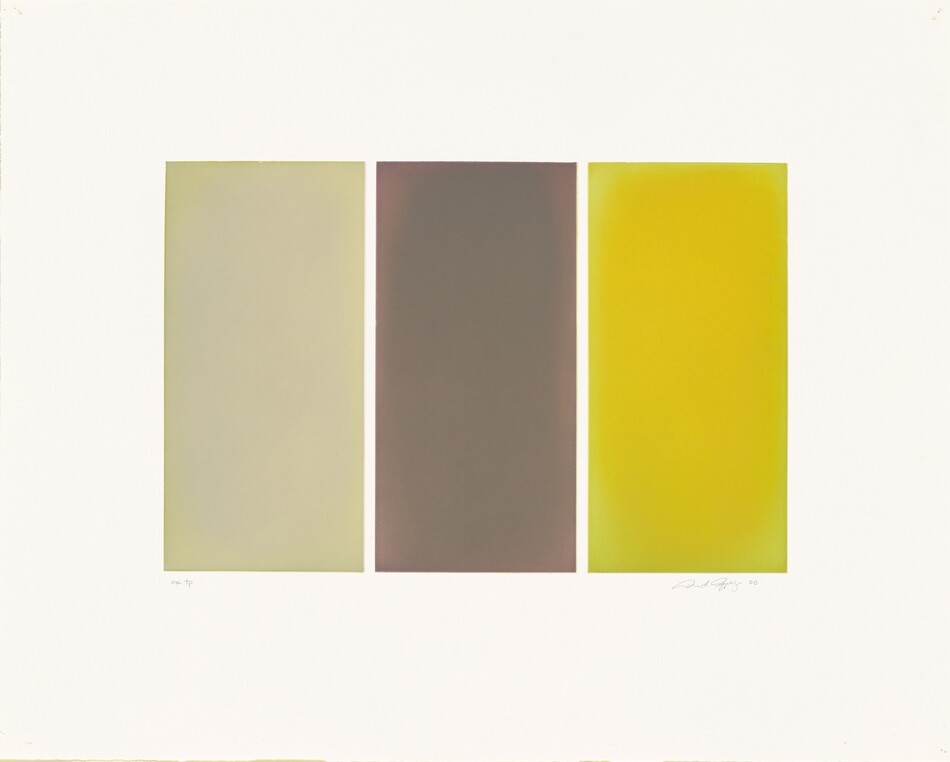
  • The image shows three vertical rectangles in different solid colors. The left rectangle is a muted greenish-gray, the central one is a subdued mauve, and the right one is a vibrant yellow.
  • The image features swirling and organic shapes converging towards the center. Bold colors of red, yellow, and green form patterns, with blue and purple hues in the background.
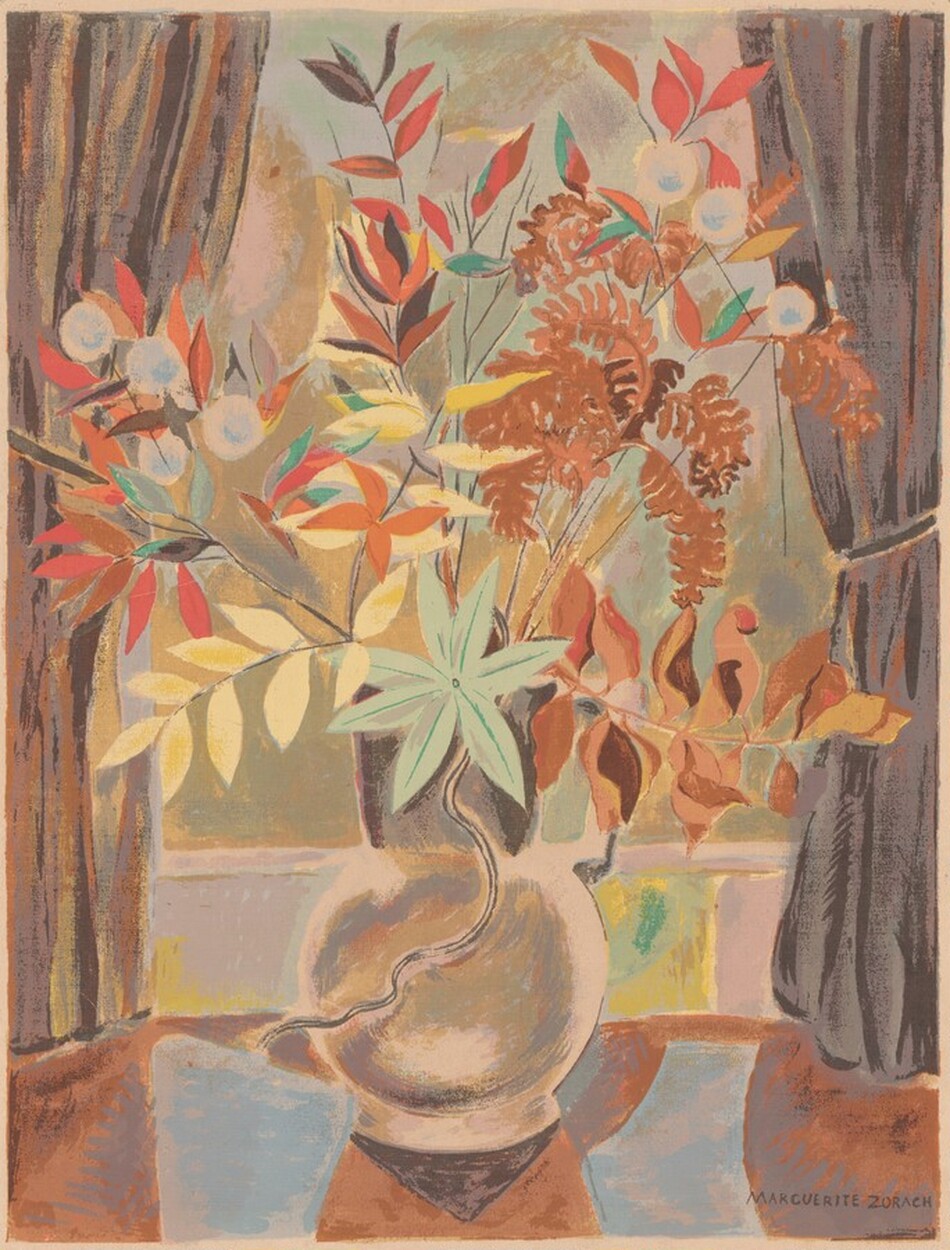
  • The image shows a large curvaceous vase in the central foreground, filled with a variety of colorful leaves and flowers. The color palette includes shades of reds, browns, yellows, muted greens, and blues. The vase is placed on a checkered surface, with draped curtains on either side in the background.
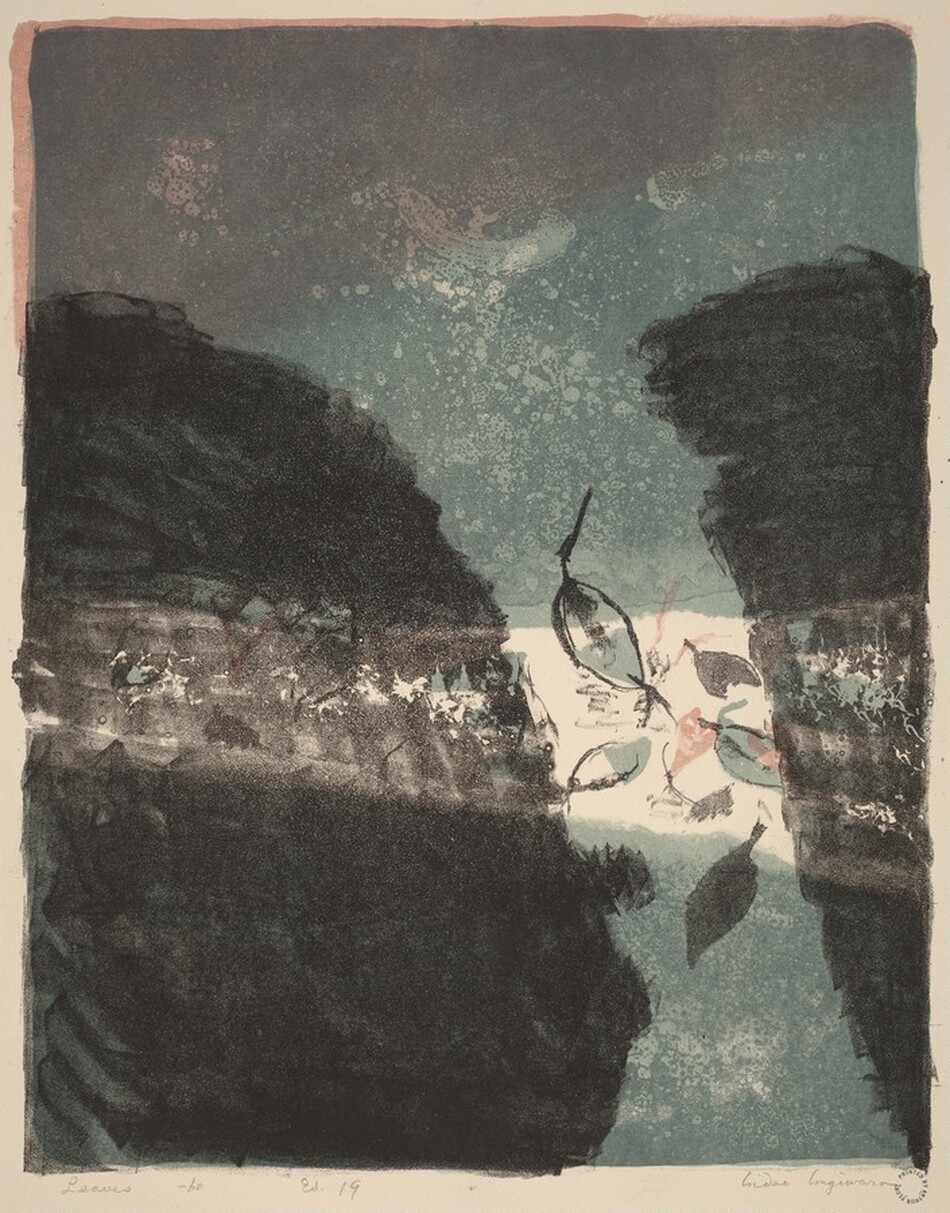
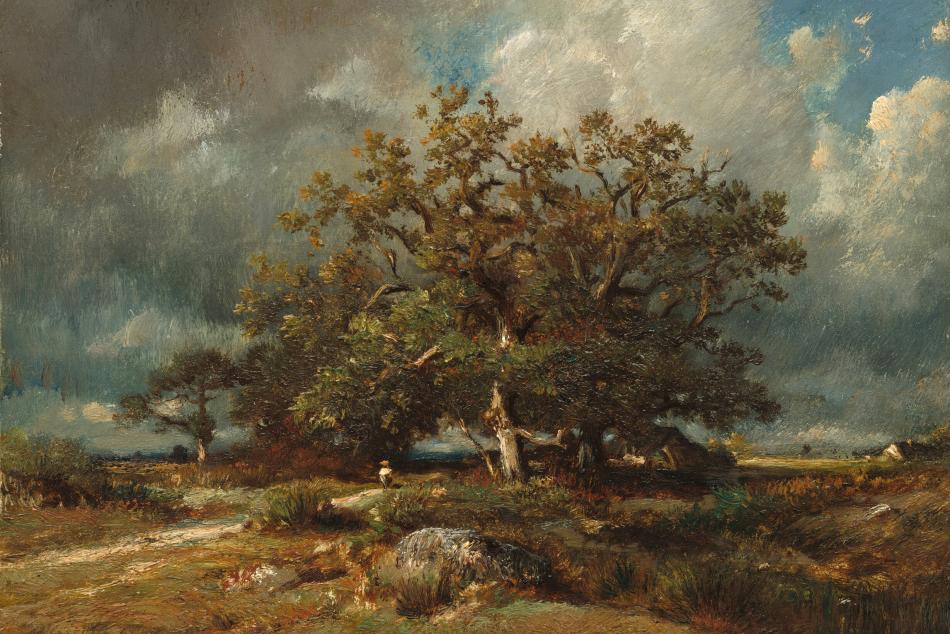
  • The image shows a view through an overhanging canopy with dark forms framing a scene of delicate details. The landscape implies a narrow passage through dense foliage. The brushstrokes are layered and textured, contributing to the realistic yet abstract quality. Shadowy masses of dark trees or rocks create enclosure close by, while in the distance hints of white and pale blue suggest the sky. The color palette includes deep blacks, teal, soft whites, and subtle hints of pink. Leaves in the center are painted with subdued yet precise strokes, contrasting with the surrounding dark shades.
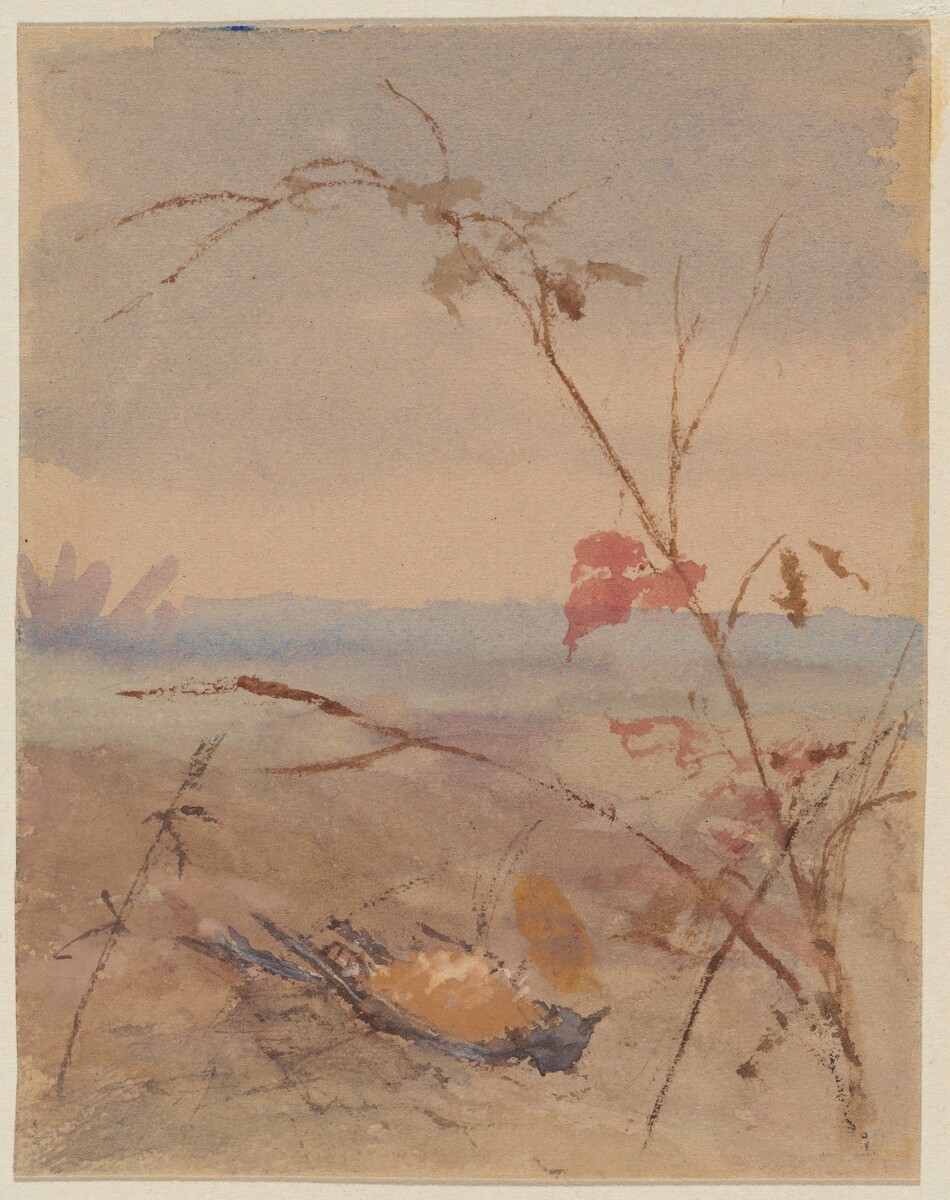
  • This is a painting of a landscape scene featuring a bird. The artwork captures a scene with earthy tones and soft brushwork, depicting a tranquil scene where a bird lies on a textured ground composed of warm browns and blues. The lines suggest a natural setting, enhanced by a blend of muted pinks, browns, and blues for the sky. The image is divided into two portions by tall, thin branches with occasional leaves. There is an air of stillness and simplicity.
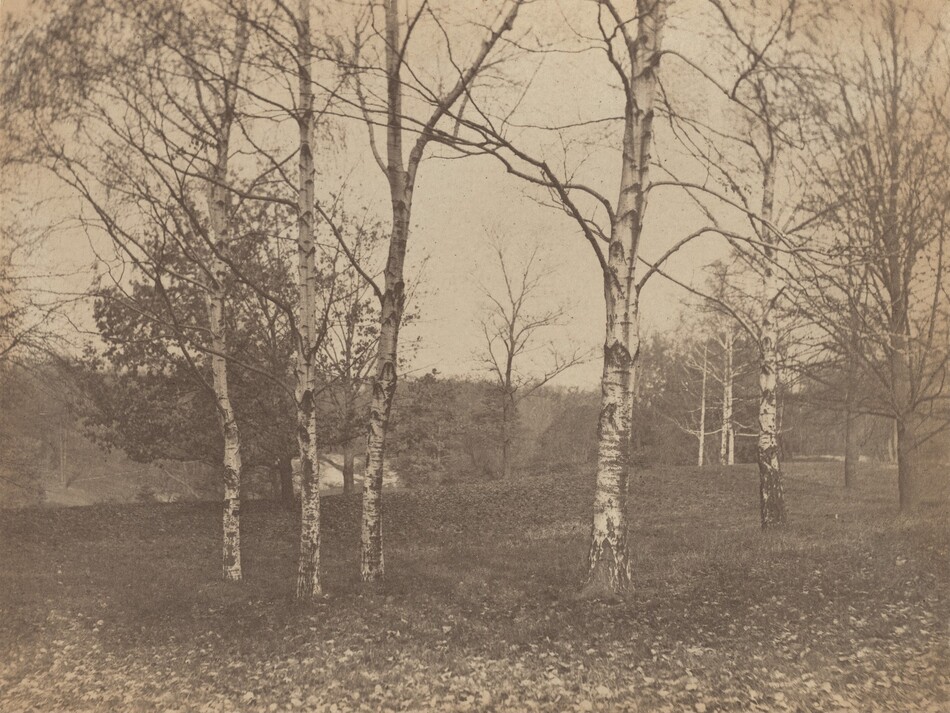
  • The image shows a park or wooded area with five tall birch trees. The horizon is low, with additional partially visible trees. The image is monochrome with a sepia tone. Fallen leaves are scattered on the ground with patches of grass. Barren trees are in the distance, intermingling branches with the closer trees against the sky. The overall color tone is warm and muted.
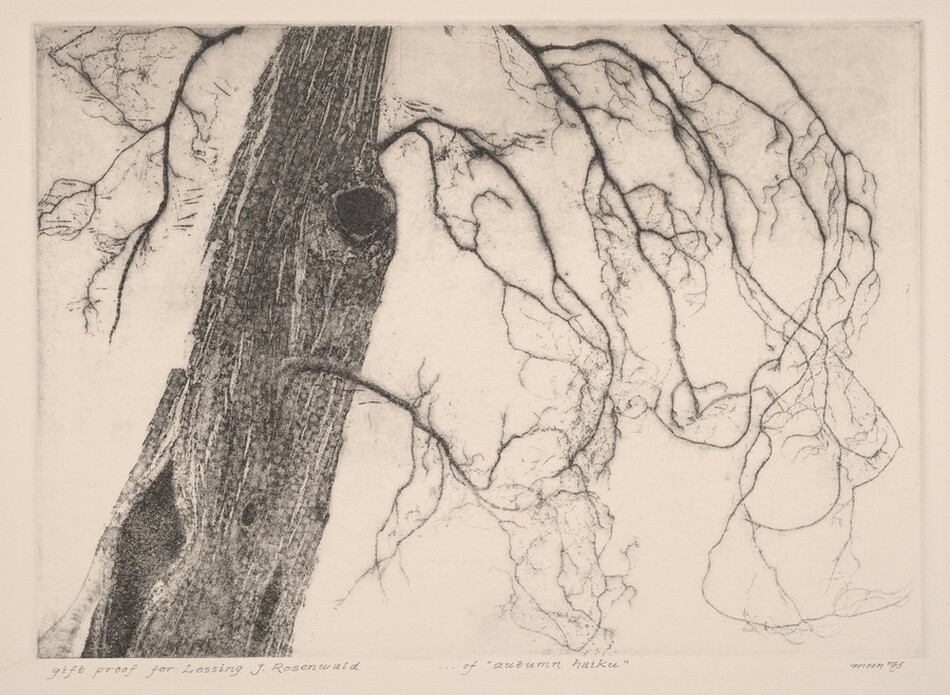
  • The image shows a close-up view of a tree trunk on the left side with intricate, branching lines extending across the composition. The focus is on the texture of the tree and the network of branches against a light background. There is no distinct horizon in the image. The style features fine, textured lines and detailed patterns capturing the tree bark and branches, resembling etching or pen work. The color palette is monochromatic with shades of black and gray on a beige background, emphasizing the interplay of light and shadow and the detailed line work.
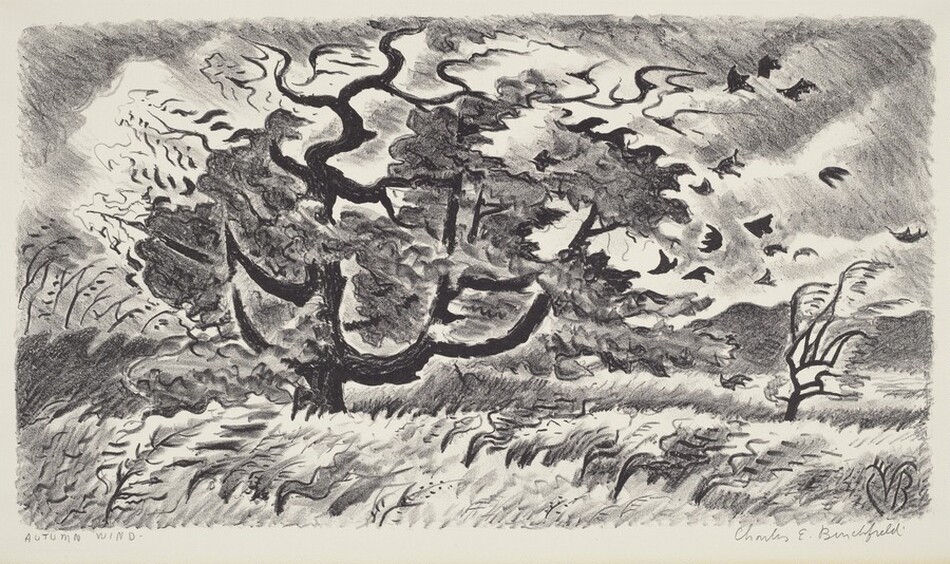
  • The image shows a tree in a windy scene. The horizon is low, the sky has swirling clouds, and birds are flying in the wind. The brushstrokes are expressive with dynamic lines depicting the wind and movement. The artwork uses black, white, and grey colors. Grasses and leaves near the tree appear wind-blown, with the tree's branches bending. In the background, there are distant hills.
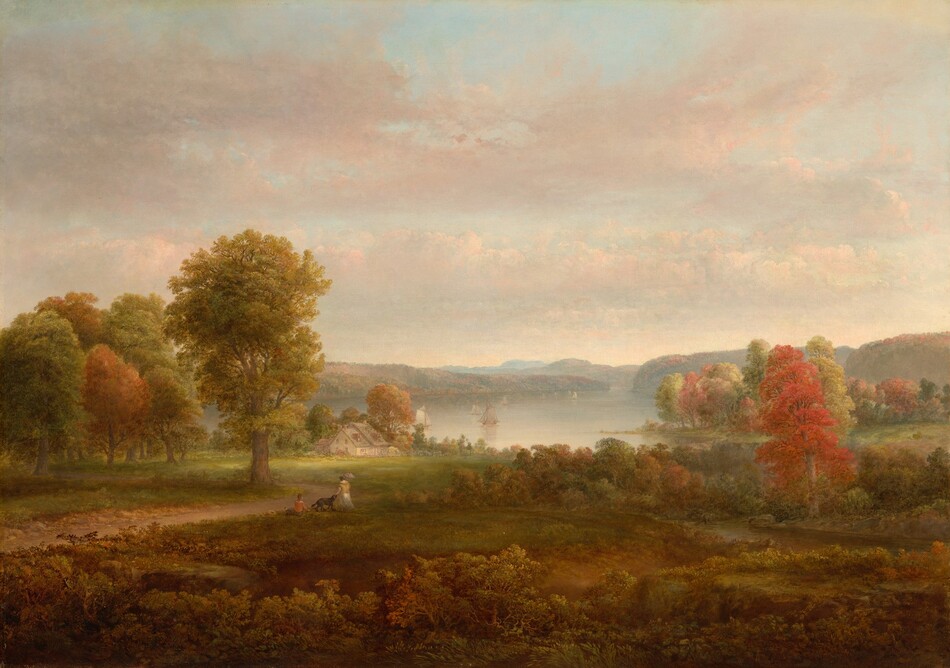
  • This painting depicts a rural landscape. The viewpoint is slightly elevated, offering a wide view of rolling hills, trees, and sailboats on a pale-blue body of water in the center. Closer to us, there is a grassy area with two people and a dog. Both people have their backs to us. One person is standing, wearing a white dress with a yellow jacket, and the other person is sitting, wearing a red shirt and brown pants. Various colors are present in the foliage, including greens, reds, and oranges, suggesting autumn. The sky is pale blue with pale pink clouds

You may also like

Article:  Portraits of Trees, a Favorite Subject of Artists

Many artists have painted, photographed, and drawn nature’s magnificent sculptures.
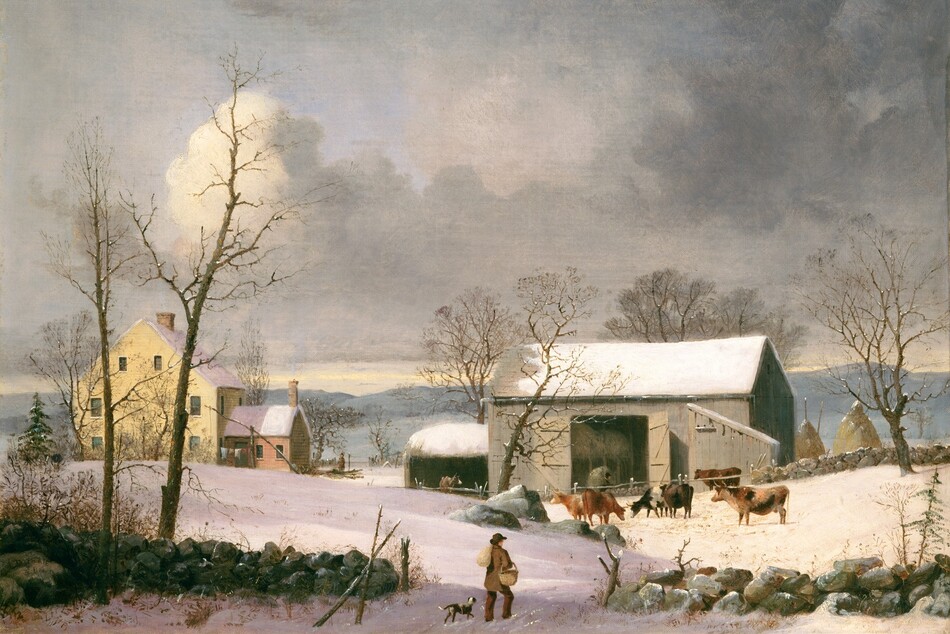
A person and dog trudge through ankle-deep snow to approach a barn and farmhouse under a heavy, lead-gray sky in this horizontal landscape painting. The person has pale-toned skin and wears a brown hat and suit. He carries a sack over one shoulder and a handled basket looped over his other forearm. He walks away from us and to our right so the side of his face is painted with a triangular touch of peach. The dog is mostly brown with some gray spots. The pair approach a break in a stone wall built with light and dark gray boulders. Snow sits in the crooks of branches in barren trees and bushes to the left and right. A short distance away, six cows stand looking off to our left or nuzzle through the snow to find grass. A gray-sided, snow-topped barn is just beyond them to the right of center. More trees and other smaller structures are around and behind the barn. Another stone wall stretches from the right side of the barn and off the right edge of the painting. The main section of the three-story house to the left is butter yellow. A single-story structure jutting off the right side of the house is pale terracotta red. Laundry hangs on a line outside the house, and a person, also wearing brown, stands nearby. On the roofs, the snow is painted white where the low sun falls and mauve-pink where it falls into shadow. The distant horizon, which comes about a third of the way up this composition, is lined with slate-gray hills. A strip of warm yellow light lines the horizon beneath piles of gray clouds that mostly obscure a lavender-blue sky. The artist signed the painting as if he had inscribed a boulder in the lower right corner, “DURRIE N HAVEN.”

Article:  Enjoy Winter Art Favorites at the National Gallery

Explore some of our favorite snowy scenes.